
Dispersing Additives
Wetting and dispersing agents for efficient pigment wetting, full colour development, faster grinding and long-term resistance to re-agglomeration in waterborne, solventborne and UV systems.
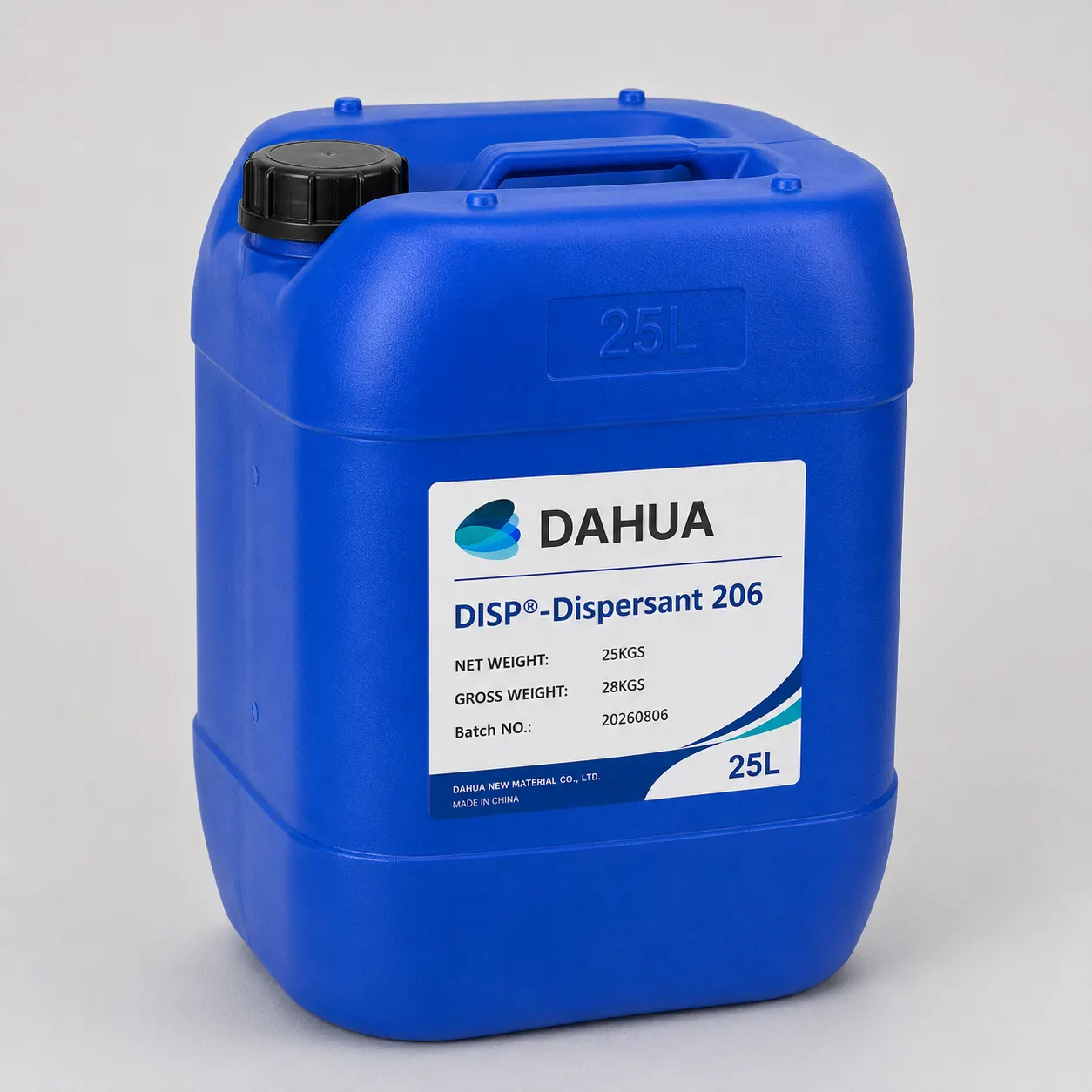
Typical application systems
Chemistry directions
- Polymeric dispersants
- Polyacrylate types
- Wetting dispersants for waterborne
- Universal solvent-borne grades
How it works
A dispersing additive adsorbs onto the pigment surface and stabilises the separated particles, sterically, electrostatically or both, so the energy you put into grinding is not lost to flocculation during storage.
What it solves
- Weak colour strength and poor gloss after let-down
- Long grinding cycles and high energy consumption
- Viscosity rise and settling during storage
- Flooding and floating in multi-pigment systems
Available grades
Full technical data sheets available on request.
| Grade | Alternative | System | Chemistry | Active content | Dosage | Features | TDS | Samples |
|---|---|---|---|---|---|---|---|---|
| DH-1100 | BYK-154 / EFKA 4010 | Water-borne | Polyacrylate salt solution | 40% | 0.3–1.5% on pigment | Inorganic pigments, good gloss, low foam tendency | Request → | |
| DH-1200 | Lubrizol Solsperse 32500 | Solvent-borne | Modified polyurethane | 50% | 10–25% on pigment | Organic pigments, colour development, broad compatibility | Request → | |
| DH-1300 | Lubrizol Solsperse 32000 / BYK-9076 | Water-borne · Solvent-borne | High molecular block copolymer | 40% | 15–40% on pigment | Universal, carbon black, storage stability | Request → | |
| DH-1400 | TEGO Dispers 652 | Water-borne | Polymeric wetting dispersant | 100% | 0.5–2.0% total | Titanium dioxide, filler dispersion, viscosity reduction | Request → |
Where this family is used
Industrial Coatings
A balanced additive package for coatings that have to be made every day, not just demonstrated once.
Printing Inks
Colour development that holds up under press-room reality.
Wood Coatings
Surface control for substrates that are never twice the same.
Automotive Coatings
Surface chemistry where there is no room for a second attempt.
Produced in our own facility
Dispersing Additives is manufactured at our production base in Foshan, Guangdong, with incoming raw material inspection, in-process control and batch release testing.
Production & quality →Production
Own manufacturing base in Foshan, Guangdong
Quality control
Incoming, in-process and batch release testing
Application lab
Formulation tested on your system
Selection guides for this family
Selecting Dispersants for Solvent-based Coating Systems
In solventborne systems the dispersant works almost entirely through steric stabilisation. How anchor groups, solvated chain length and binder interactions decide grinding efficiency, colour development and storage stability.
A Practical Dispersant Selection Guide for Pigment Grinding
Colour strength, grinding efficiency and storage stability pull dispersant selection in different directions. How pigment surface polarity, molecular architecture and dosage on pigment interact in practice.